http://www.ti.com/general/docs/suppproductinfo.tsp?distId=26&gotoUrl=https%3A%2F%2Fwww.ti.com%2Flit%2Fgpn%2Fmspm0l1303″>View Datasheet

Texas Instruments MSPM0L130x/MSPM0L130x-Q1 Arm® Cortex®-M0 MCUs

Texas Instruments MSPM0L130x/MSPM0L130x-Q1 Arm® Cortex®-M0 Microcontrollers (MCUs) comprise the MSP highly-integrated ultra-low-power 32-bit MSPM0 MCU family. These devices are based on the enhanced Arm Cortex-M0+ core platform operating at up to 32MHz frequency. These cost-optimized MCUs offer high-performance analog peripheral integration, support extended temperature ranges from -40°C to 105°C, and work with supply voltages from 1.62V to 3.6V.

The MSPM0L130x/MSPM0L130x-Q1 devices provide up to 64KB embedded flash program memory with up to 4KB SRAM. These MCUs incorporate a high-speed on-chip oscillator with an accuracy of up to ±1.2%, eliminating the need for an external crystal. Additional features include a 3-channel DMA, 16- and 32-bit CRC accelerator, and various high-performance analog peripherals such as one 12-bit 1.68MSPS ADC with configurable internal voltage reference and one high-speed comparator with built-in reference DAC. These devices include two zero-drift zero-crossover operational amplifiers with programmable gain, one general-purpose amplifier, and an on-chip temperature sensor. These devices offer intelligent digital peripherals such as four 16-bit general-purpose timers, one windowed watchdog timer, and various communication peripherals, including two UARTs, one SPI, and two I2Cs. These communication peripherals offer protocol support for LIN, IrDA, DALI, Manchester, Smart Card, SMBus, and PMBus.

The Texas Instruments MSPM0L130x/MSPM0L130x-Q1 family of low-power MCUs consists of devices with varying degrees of analog and digital integration to let customers find the MCU that meets the user’s project needs. The architecture combined with extensive low-power modes is optimized to achieve extended battery life in portable measurement applications. The MSPM0L130x-Q1 devices are AEC-Q100 qualified for automotive applications.
Features

  • Core
    • Arm 32-bit Cortex-M0+ CPU, frequency up to 32MHz
  • Operating characteristics
    • –40°C to 125°C extended temperature
    • 1.62V to 3.6V wide supply voltage range
  • Memories
    • Up to 64KB of Flash
    • Up to 4KB of SRAM
  • High-performance analog peripherals
    • One 12-bit 1.68Msps analog-to-digital converter (ADC) with up to 10 total external channels
    • Configurable 1.4V or 2.5V internal ADC voltage reference (VREF)
    • Two zero-drift, zero-crossover chopper operational amplifiers (OPA)
      • 0.5µV/°C drift with chopping
      • 6pA input bias current (MSPM0L134x only)
    • Integrated programmable gain stage (1-32x)
    • One general-purpose amplifier (GPAMP)
    • One high-speed comparator (COMP) with 8-bit reference DAC
      • 32ns propagation delay
      • Low power mode down to < 1µA
    • Programmable analog connections between ADC, OPAs, COMP, and DAC
    • Integrated temperature sensor
  • Optimized low-power modes
    • RUN: 71µA/MHz (CoreMark)
    • STOP: 151µA at 4MHz and 44µA at 32kHz
    • STANDBY: 1.0µA with 32kHz 16-bit timer running, SRAM/registers fully retained, and 32MHz clock wakeup in 3.2µs
    • SHUTDOWN: 61nA with IO wakeup capability
  • Intelligent digital peripherals
    • 3-channel DMA controller
    • 3-channel event fabric signaling system
    • Four 16-bit general-purpose timers, each with two capture/compare registers supporting low-power operation in STANDBY mode, supporting a total of eight PWM channels
    • Windowed watchdog timer
  • Enhanced communication interfaces
    • Two UART interfaces; one supports LIN, IrDA, DALI, Smart Card, Manchester, and both support low-power operation in STANDBY
    • Two I2C interfaces; one supports FM+ (1Mbit/s), and both support SMBus, PMBus, and wakeup from STOP
    • One SPI supports up to 16Mbit/s
  • Clock system
    • Internal 4MHz to 32MHz oscillator with ±1.2% accuracy (SYSOSC)
    • Internal 32kHz low-frequency oscillator with ±3% accuracy (LFOSC)
  • Data integrity
    • Cyclic redundancy checker (CRC-16 or CRC-32)
  • Flexible I/O features
    • Up to 28 GPIOs
    • Two 5V-tolerant open-drain IOs with fail-safe protection
  • Development support
    • 2-pin serial wire debug (SWD)
  • Package options
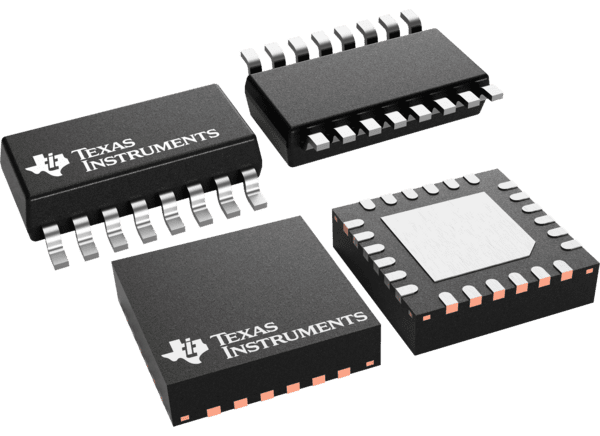
    • 32-pin VQFN (RHB)
    • 28-pin VSSOP (DGS)
    • 24-pin VQFN (RGE)
    • 20-pin VSSOP (DGS)
    • 16-pin SOT (DYY), WQFN (RTR)(WQFN package will be coming soon)
  • Family members
    • MSPM0L13x3: 8KB of Flash, 2KB of RAM
    • MSPM0L13x4: 16KB of Flash, 2KB of RAM
    • MSPM0L13x5: 32KB of Flash, 4KB of RAM
    • MSPM0L13x6: 64KB of Flash, 4KB of RAM
  • Development kits and software
    • LP-MSPM0L1306 LaunchPad™ development kit
    • MSP Software Development Kit (SDK)

Applications

  • Battery charging and management
  • Power supplies and power delivery
  • Personal electronics
  • Building security and fire safety
  • Connected peripherals and printers
  • Grid infrastructure
  • Smart metering
  • Communication modules
  • Medical and healthcare
  • Lighting

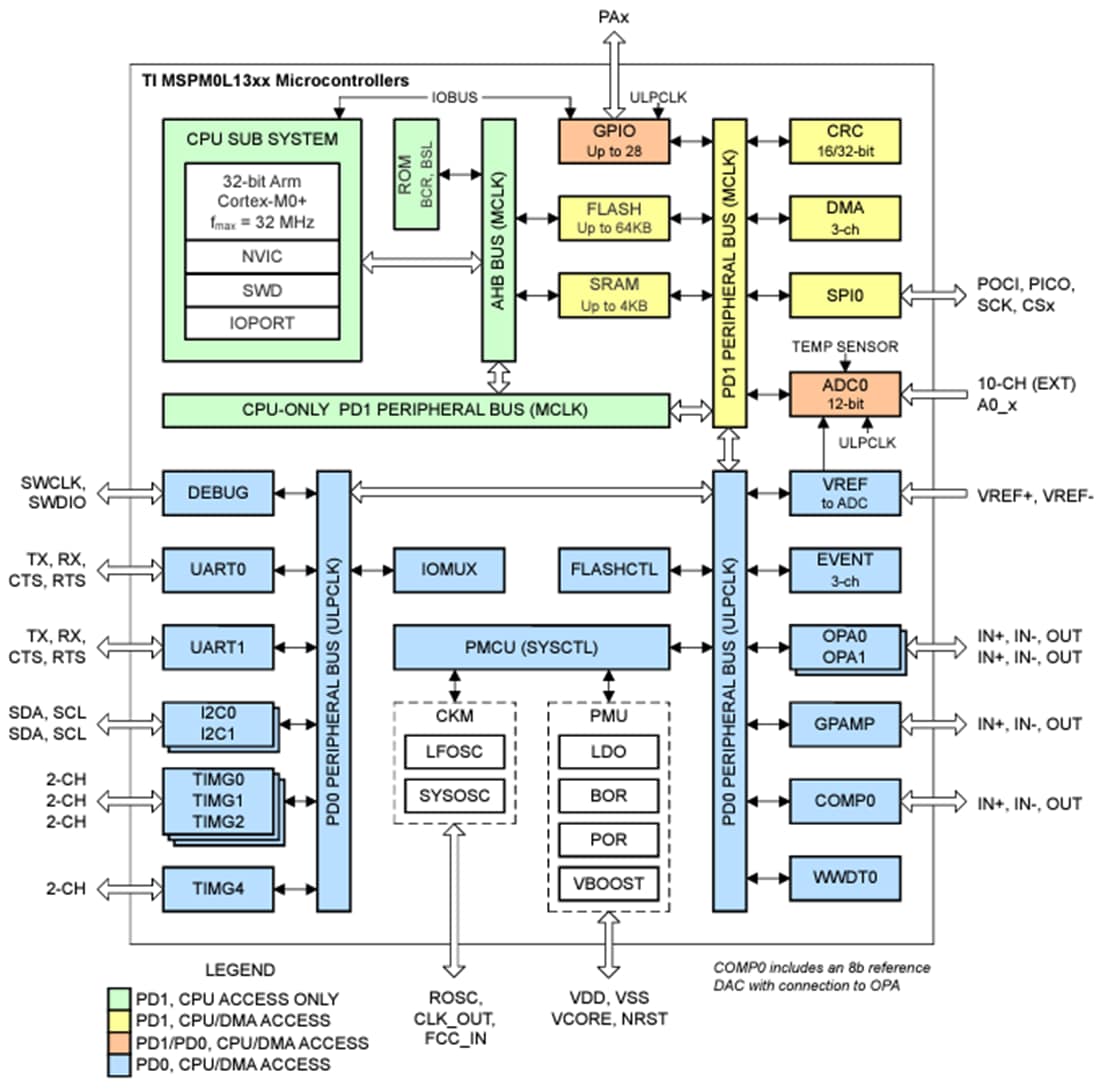
Functional Block Diagram

Block Diagram - Texas Instruments MSPM0L130x/MSPM0L130x-Q1 Arm® Cortex®-M0 MCUs

Texas Instruments MSPM0L130x/MSPM0L130x-Q1 Arm® Cortex®-M0 MCUs