- support@husseinkey.com
- livechat


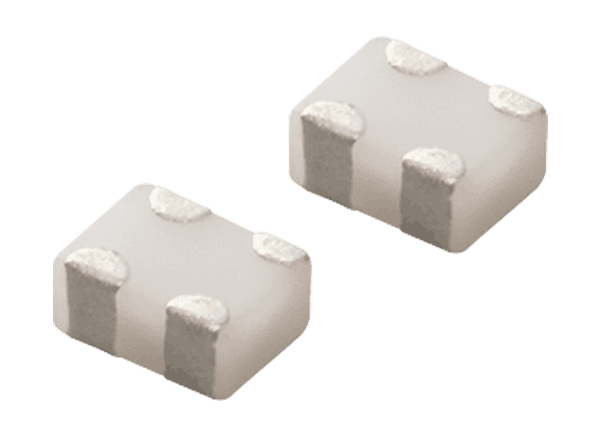
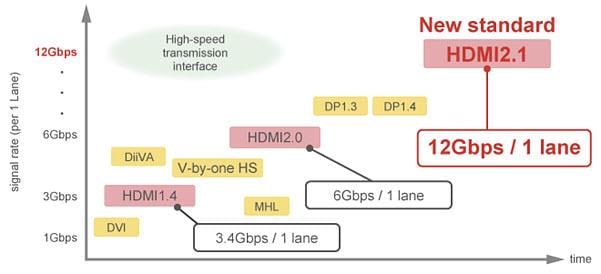
HDMI is a digital interface using differential signaling and is designed for the transmission of digital video and audio. The interface is widely used throughout the audio-visual market. HDMI 2.1 is an extension of HDMI 2.0, and it supports speeds that are twice as fast as HDMI 2.0.
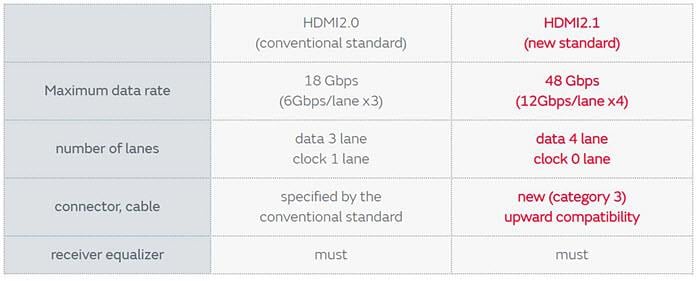
HDMI 2.1 has a maximum bandwidth that is about 2.7 times that of HDMI 2.0, and its maximum signal transmission speed per lane is twice that of HDMI 2.0. While HDMI 2.0 consists of three data lanes and a clock lane, HDMI 2.1 does not have a clock lane and instead has four data lanes.
In this way, HDMI 2.1 transmits signals faster than before. Therefore, care must be taken to ensure the signal quality is not harmed when implementing noise suppression measures.
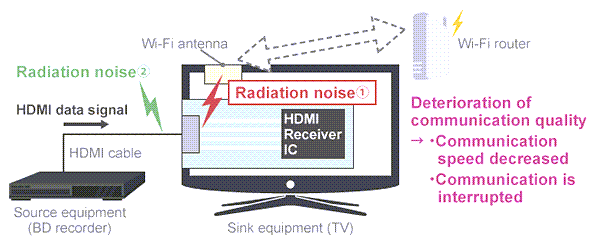
Two noise issues are plausible when HDMI communication is performed:
• Radiation noise 1: Noise originating from HDMI interferes with the Wi-Fi® antenna inside the equipment, reducing the Wi-Fi communication sensitivity (Intrasystem EMC).
• Radiation noise 2: Noise is radiated from the HDMI equipment or cable (Emissions)
Murata’s study focuses on the intrasystem EMC of radiation noise 1 and examines corrective actions for it.
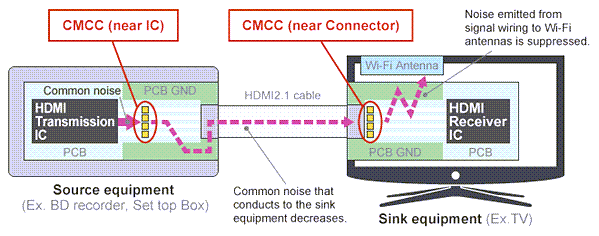
If regular noise filters are used for high-speed differential signaling lines like HDMI, the signal quality will deteriorate and the signals will not be transmitted properly. For this reason, common mode choke coils (CMCC) are a suitable solution. Because HDMI signals are high speed, Murata selected a CMCC that is best suited for high-speed signals. CMCCs are installed near the output pins of the IC at the HDMI source side and near the connectors at the sink side.
The source-side CMCC installed near the IC can suppress the common-mode noise generated from the transmission ICs at the source side. This is achieved by preventing the propagation of common-mode noise at the sink side.
The sink-side CMCC can suppress the common-mode noise generated from the HDMI signal wiring of the sink equipment by keeping common-mode noise from entering the Wi-Fi antenna.
These Murata CMCCs are recommended for HDMI 2.1 noise suppression measures:
• DLM0NSB120HY2D
• DLM0QSB120HY2D – High common-mode impedance and superior noise suppression performance
• NFG0QHB542HS2D – Extremely small effect on signals
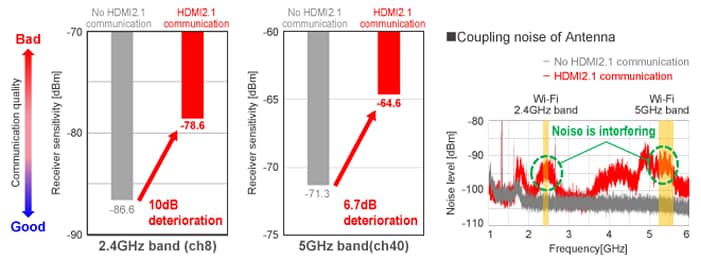
Murata first verified how much HDMI communication affects Wi-Fi. It confirmed that when HDMI 2.1 communication was started, the Wi-Fi reception sensitivity dropped by 6dB to 10dB in the 2.4GHz and 5GHz bands. When noise actually entering the Wi-Fi was confirmed, Murata determined it overlapped with the 2.4GHz and 5GHz bands.
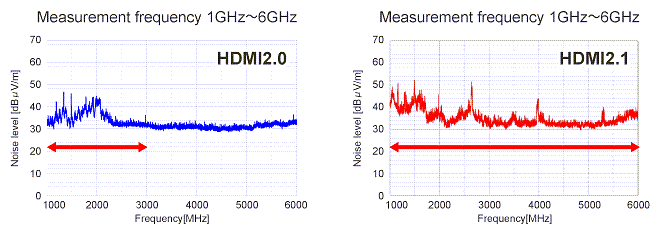
Murata then examined noise suppression measures for radiation noise. First, it checked for differences in the noise spectra for HDMI 2.0 and HDMI 2.1.
• Radiation noise from conventional HDMI 2.0
▪ Broad noise occurs in the 1GHz to 3GHz frequency band
• Radiation noise from HDMI 2.1
▪ Noise occurs in the 1GHz to 6GHz frequency band
This showed Murata that higher frequency noise occurred in HDMI 2.1.
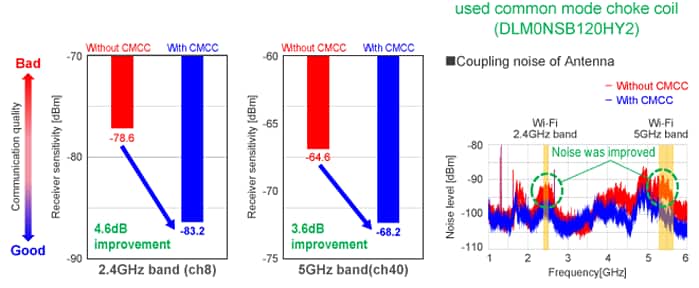
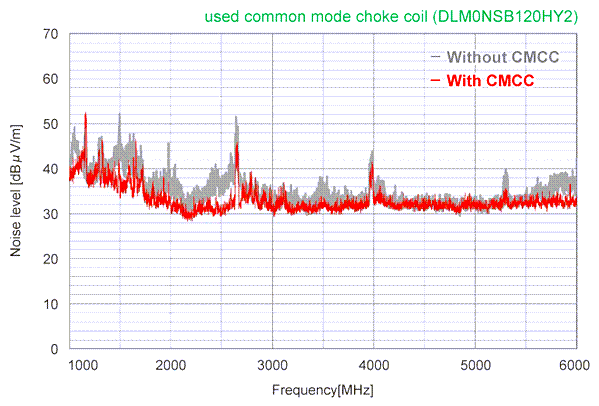
Mounting a CMCC (DLM0NSB120HY2) to the source side enables the removal of HDMI 2.1 noise. Radiation noise is still left after using a CMCC, but much of this noise was radiation noise of the DRAM, installed separately on the board of the source equipment.
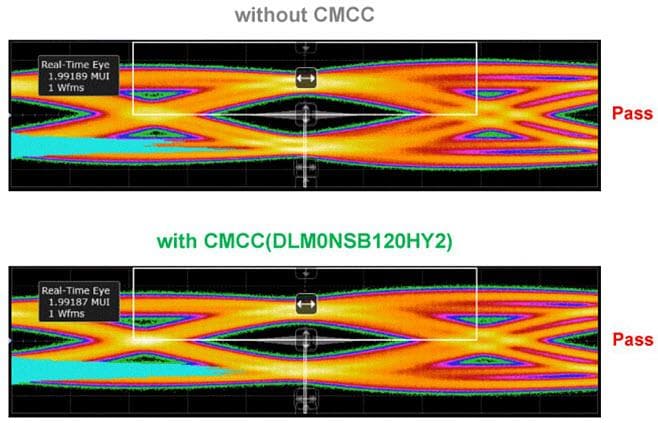
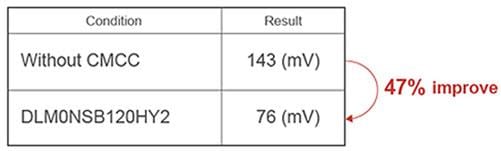
The eye mask test for HDMI 2.1 showed the signal waveform was identical — even after using CMCCs. The AC common mode noise was reduced by 47% by using CMCCs.
• Measures for preventing drops in Wi-Fi reception sensitivity
▪ An issue arose where the Wi-Fi reception sensitivity dropped during HDMI 2.1 communication, but this was improved by using CMCCs.
• Noise suppression measures for radiation noise (measures for preventing emissions)
▪ In HDMI 2.1, radiation noise occurred in the range from 1GHz to 6GHz, but this was improved by using CMCCs.
• Effect on the signal waveform
▪ Inserting CMCCs had no effect on the eye mask test.
▪ Use of CMCCs reduced the AC common-mode voltage.
Murata Community Forum provides searchable content with various discussion topics, popular blogs, and articles. The Murata broad market support team holds regular reviews to discuss open issues, allowing inquiries to be answered in a timely manner. The forum content is freely accessible to the public. However, users must log in to post questions or answers. Registration is free of charge.


