- support@husseinkey.com
- livechat


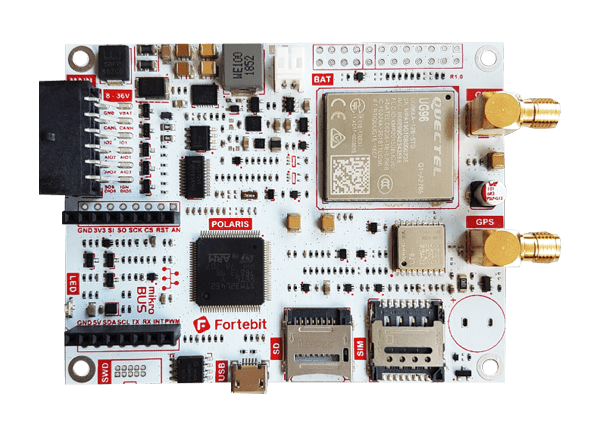
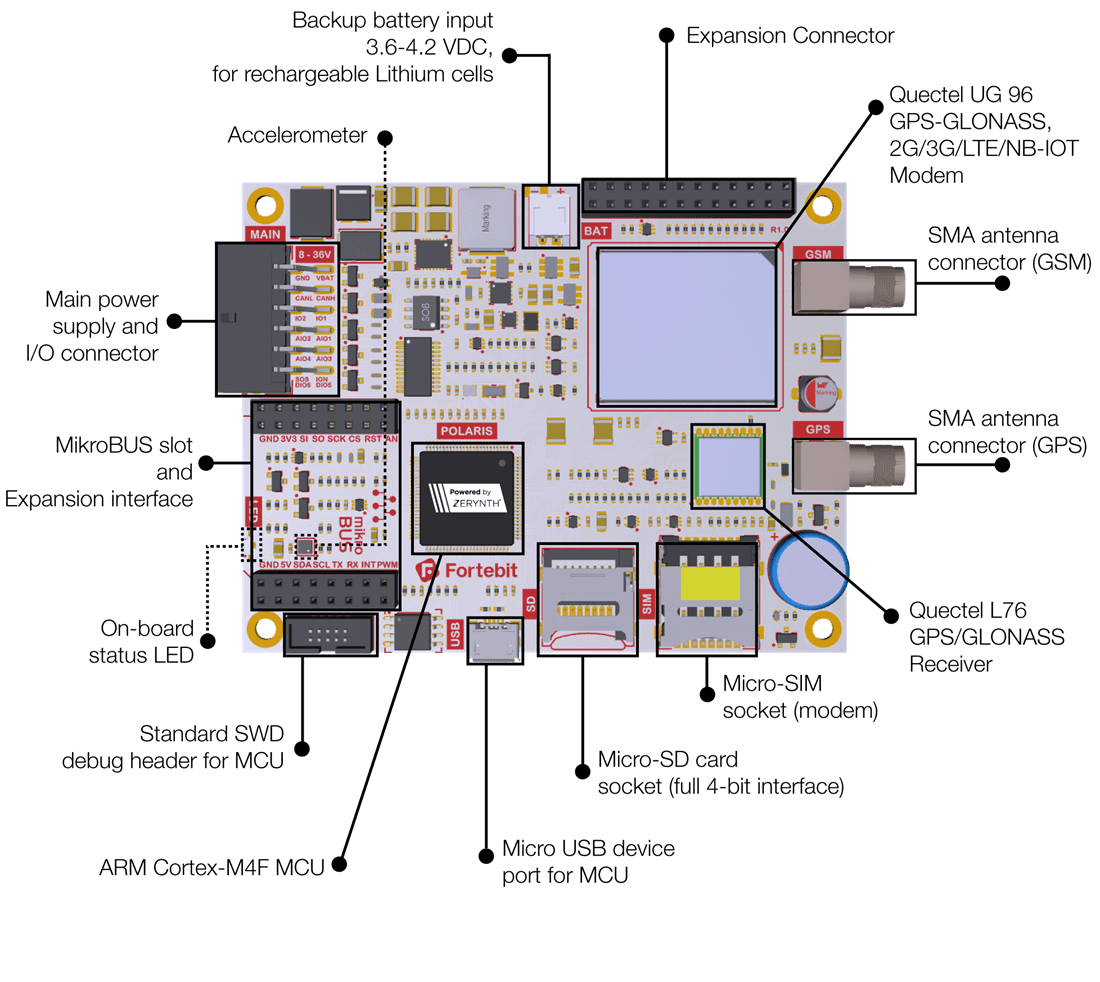
Fortebit POL-NB Polaris Vehicle IoT Platform can function as a GPS/GLONASS vehicle tracker, available with a NB-IoT modem. It is a Python programmable open IoT platform, ready to connect to the Cloud with just a few lines of code. Polaris is also 100% Arduino compatible. The POL-NB is designed with features like geofencing, real-time tracking, analog sensors, external commands, audio, and SMS. It is the evolution of the OpenTracker, the most popular open-source vehicle tracker board in the world, which Fortebit developed in 2014.
With IoT in mind, the POL-NB is Zerynth-powered and Python programmable. With the Zerynth license onboard, the user can program it in Python right out of the box. Zerynth also allows C/Python hybrid programming. The full Python application is released open-source. Zerynth has a really small footprint. It requires just 60k-80kB of Flash and 3-5kB of RAM. Zerynth also integrates the RTOS of the user’s choice with multithreading support. When it comes to security, it offers support for HTTPS, SSL/TLS, secure hardware encryption, and Blockchain.
The POL-NB is natively supported by the Arduino IDE, taking advantage of the vast Arduino codebase. The full Arduino application is released open-source on the GitHub channel. The POL-NB also allows the user to add a Li-Po battery and run it without the car battery. For example, it can be added to a bicycle, thanks to that external power source. With several analog inputs, it can be connected to various sensors or collect data from the CAN bus. Several digital outputs are also available to directly control relays or other external loads. The sensor data can then be easily sent to the Cloud for remote monitoring. This makes POL-NB ideal for industrial machinery where it is required to measure things like oil pressure, crane positioning, and so on.
The POL-NB is quite versatile and expandable. There are plenty of digital and analog I/O, communication interfaces like SPI, I2C and UART, and a MikroBUS™ slot, which allows the user to take advantage of more than 600 Click boards. This means the user can add all sorts of functionalities to Polaris, from OLED displays, buttons, and UV sensors to motor control and motion sensors.
USB Cables / IEEE 1394 Cables USB to UART interface (FTDI FT232R IC, 1.8m length, Hirose 6-pin connector)
Antennas GSM/GNSS combo antenna with double SMA connector
Specialized Cables Cable 50cm length 12pin with mFit Molex connector
Polaris Aluminium Case Includes the aluminum case, screws, and LED pipe