Microchip Technology AVR DD 8-Bit Microcontrollers

Microchip Technology AVR DD 8-Bit Microcontrollers are based on the AVR® CPU with a hardware multiplier running at clock speeds up to 24MHz. The AVR DD MCUs include 16KB to 64KB of Flash, 2KB to 8KB of SRAM, and 256 bytes of EEPROM. The AVR DD MCUs build upon the low-power performance of the AVR architecture with a world-class selection of Core Independent Peripherals (CIPs) and a fully loaded intelligent analog portfolio, providing designers with the freedom to create innovative designs. With a comprehensive feature set, including Multi-Voltage Input/Output (MVIO), the AVR DD MCUs are perfectly suited for complex applications or as a companion microcontroller in complex designs with multiple power domains.

The AVR DD MCUs leverage onboard CIPs and a 5V operation mode for increased noise immunity while reducing system latency by using the powerful Event System (EVSYS) and Configurable Custom Logic (CCL) peripherals. The Multi-Voltage I/O (MVIO) feature of the AVR DD MCUs allows true level-shifted bi-directional communication with devices on a different power domain, which removes the need for a level shifter. This flexibility makes these devices excellent for real-time control functions in industrial control, home appliances, automotive, Internet of Things (IoT), and other applications.

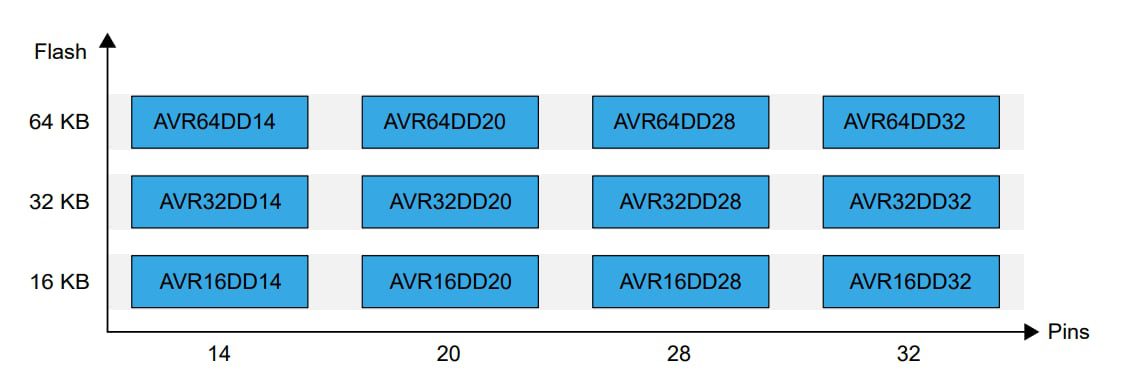
The Microchip Technology AVR DD 8-Bit Microcontrollers are offered in 14-, 20-, 28-, and 32-pin packages. Vertical migration through the series is easily possible without code modification, as these devices are fully pin- and feature-compatible.

The AVR DD MCUs are Functional Safety Ready and suitable for safety-critical applications targeting industrial and automotive products (IEC 61508 and ISO 26262).
Features

  • AVR® CPU
    • Running at up to 24MHz
    • Single-cycle I/O access
    • Two-level interrupt controller
    • Two-cycle hardware multiplier
    • Supply voltage range: 1.8V to 5.5V
  • Memories
    • 16/32/64KB in-system self-programmable Flash memory
    • 2/4/8KB SRAM
    • 256B EEPROM
    • 32B of user row in nonvolatile memory that can keep data during chip erase and be programmed while the device is locked
    • Write/erase endurance
    • Flash 10,000 cycles
    • EEPROM 100,000 cycles
    • Data retention 40 years at 55°C
  • System
    • Power-on Reset (POR) circuit
    • Brown-out Detector (BOD)
    • Clock options
    • High-precision internal high-frequency oscillator with selectable frequency up to 24MHz (OSCHF)
      • Auto-tuning for improved internal oscillator accuracy
    • Internal PLL up to 48MHz for the high-frequency operation of Timer/Counter type D (PLL)
    • 32.768kHz ultra-low-power internal oscillator (OSC32K)
    • 32.768kHz external crystal oscillator (XOSC32K)
    • External clock input
    • External high-frequency crystal oscillator (XOSCHF) with clock failure detection
      • Single-pin Unified Program and Debug Interface (UPDI)
      • Three sleep modes
    • Idle with all peripherals running for immediate wake-up
    • Standby with a configurable operation of selected peripherals
    • Power-Down with full data retention
      • Automated Cyclic Redundancy Check (CRC) Flash memory scan
      • Watchdog Timer (WDT) with Window mode, with a separate on-chip oscillator
      • External interrupt on all general-purpose pins
  • Peripherals
    • One 16-bit Timer/Counter type A (TCA) with three compare channels for Pulse-Width Modulation (PWM) and waveform generation
    • Up to three 16-bit Timer/Counter type B (TCB) with input capture and signal measurements
    • One 12-bit PWM Timer/Counter type D (TCD) optimized for power control
    • One 16-bit Real-Time Counter (RTC) that can run from an external crystal or internal oscillator
    • Up to two USARTs
    • Operation modes RS-485, LIN slave, master SPI, and IrDA
    • Fractional baud rate generator, auto-baud, and start-of-frame detection
      • One SPI with master/slave operation modes
      • One Two-Wire Interface (TWI) with dual address match
    • Simultaneous master/slave operation (dual mode)
    • Philips Inter-Integrated Circuit (I2C) compatible
    • Standard mode (Sm, 100kHz)
      • Fast mode (Fm, 400kHz)
      • Fast mode plus (Fm+, 1 MHz)
    • Event System for CPU independent and predictable inter-peripheral signaling
    • Configurable Custom Logic (CCL) with up to four programmable Look-up Tables (LUTs)
    • One 12-bit differential 130ksps Analog-to-Digital Converter (ADC)
    • One 10-bit Digital-to-Analog Converter (DAC)
    • One Analog Comparator (AC)
    • One Zero-Cross Detector (ZCD)
    • Internal 1.024V, 2.048V, 2.500V, and 4.096V voltage references and external reference option (VREF)
  • I/O and Packages
    • Multi-Voltage I/O (MVIO) on I/O port C
    • Up to 27/26 programmable I/O pins
    • 32-pin VQFN 5×5 mm and TQFP 7×7 mm
    • 28-pin SPDIP, SSOP, and SOIC
    • 20-pin SOIC and QFN 4×4 mm
    • 14-pin SOIC
  • Temperature Ranges
    • Industrial -40°C to +85°C
    • Extended -40°C to +125°C

Family Overview

Block Diagram - Microchip Technology AVR DD 8-Bit Microcontrollers

Videos

Resources

  • AVR32DD and AVR16DD Datasheet
  • AVR64DD Datasheet
  • AVR DD Fact Sheet
  • AVR DD Product Brief

Microchip Technology AVR DD 8-Bit Microcontrollers