Espressif Systems ESP32-S3 2.4GHz Wi­-Fi® & BLUETOOTH® LE SoCs

Espressif Systems ESP32-S3 2.4GHz Wi-­Fi® and BLUETOOTH® LE SoCs offer a low-power MCU-based system-on-chip (SoC), supporting 2.4GHz Wi-Fi and Bluetooth® Low Energy (Bluetooth LE). The ESP32-S3 includes a high-performance dual-core microprocessor (Xtensa® 32-bit LX7), a low-power coprocessor, a Wi-Fi baseband, a Bluetooth LE baseband, and RF module, and peripherals. The Espressif Systems ESP32-S3 2.4GHz Wi­Fi and Bluetooth LE SoCs are ideal for smart home, Human-machine interface (HMI), and other assorted applications.
Features

  • Wi­Fi
    • IEEE 802.11b/g/n-compliant
    • Supports 20MHz, 40MHz bandwidth in 2.4GHz band
    • 1T1R mode with data rate up to 150Mbps
    • Wi-Fi Multimedia (WMM)
    • TX/RX A-MPDU, TX/RX A-MSDU
    • Immediate Block ACK
    • Fragmentation and defragmentation
    • Automatic Beacon monitoring (hardware TSF)
    • 4 × virtual Wi-Fi interfaces
    • Simultaneous support for Infrastructure BSS in Station, SoftAP, or Station + SoftAP modes
    • Antenna diversity
    • 802.11mc FTM
    • External PA is supported
  • Bluetooth
    • Bluetooth LE: Bluetooth 5, Bluetooth mesh
    • High power mode (20dBm, share the same PA with Wi-Fi)
    • Speed of 125Kbps, 500Kbps, 1Mbps, 2Mbps
    • Advertising extensions
    • Multiple advertisement sets
    • Channel selection algorithm #2
    • Internal co-existence mechanism between Wi-Fi and Bluetooth to share the same antenna
  • CPU and Memory
    • Xtensa® dual-core 32-bit LX7 microprocessor, up to 240MHz
    • CoreMark® score:
      • 1 core at 240MHz: 613.86 CoreMark; 2.56CoreMark/MHz
      • 2 cores at 240MHz: 1181.60 CoreMark; 4.92CoreMark/MHz
    • 128-bit data bus and SIMD commands
    • 384KB ROM
    • 512KB SRAM
    • 16KB SRAM in RTC
    • SPI, Dual SPI, Quad SPI, Octal SPI, QPI, and OPI interfaces that allow connection to multiple flash and external RAM
    • Flash controller with cache is supported
    • Flash In-Circuit Programming (ICP) is supported
  • Advanced Peripheral Interfaces
    • 45 × programmable GPIOs
    • Digital interfaces:
      • 4 × SPI
      • 1 × LCD interface (8-bit ~16-bit parallel RGB, I8080, and MOTO6800), supporting conversion between RGB565, YUV422, YUV420 and YUV411
      • 1 × DVP 8-bit ~16-bit camera interface
      • 3 × UART
      • 2 × I2C
      • 2 × I2S
      • 1 × RMT (TX/RX)
      • 1 × pulse counter
      • LED PWM controller, up to 8 channels
      • 1 × full-speed USB OTG
      • 1 × USB Serial/JTAG controller
      • 2 × MCPWM
      • 1 × SDIO host controller with 2 slots
      • General DMA controller (GDMA), with 5 transmit channels and 5 receive channels
      • 1 × TWAI® controller, compatible with ISO 11898-1 (CAN Specification 2.0)
    • Analog interfaces:
      • 2 × 12-bit SAR ADCs, up to 20 channels
      • 1 × temperature sensor
      • 14 × touch sensing IOs
    • Timers:
      • 4 × 54-bit general-purpose timers
      • 1 × 52-bit system timer
      • 3 × watchdog timers
  • Low Power Management
    • Power Management Unit with five power modes
    • Ultra-Low-Power (ULP) coprocessors:
      • ULP-RISC-V coprocessor
      • ULP-FSM coprocessor
  • Security
    • Secure boot
    • Flash encryption
    • 4-Kbit OTP, up to 1792 bits for users
    • Cryptographic hardware acceleration:
      • AES-128/256 (FIPS PUB 197)
      • Hash (FIPS PUB 180-4)
      • RSA
      • Random Number Generator (RNG)
      • HMAC
      • Digital signature

Applications

  • Smart home
    • Light control
    • Smart button
    • Smart plug
  • Industrial automation
    • Industrial robot
    • Mesh network
    • Human machine interface (HMI)
  • Health care
    • Health monitor
    • Baby monitor
  • Consumer Electronics
    • Smartwatch and bracelet
    • Over-the-top (OTT) devices
    • Wi-Fi and bluetooth speaker
    • Logger toys and proximity sensing toys
  • Smart agriculture
    • Smart greenhouse
    • Smart irrigation
    • Agriculture robot
  • Retail and Catering
    • POS machines
    • Service robot
  • Audio Device
    • Internet music players
    • Live streaming devices
    • Internet radio players
  • Generic low-power IoT sensor hubs
  • Generic low-power IoT data loggers
  • Cameras for video streaming
  • USB Devices
  • Speech recognition
  • Image recognition
  • Wi-Fi + Bluetooth networking card
  • Touch sensing
    • Waterproof design
    • Distance sensing applications
    • Linear slider, wheel slider designs

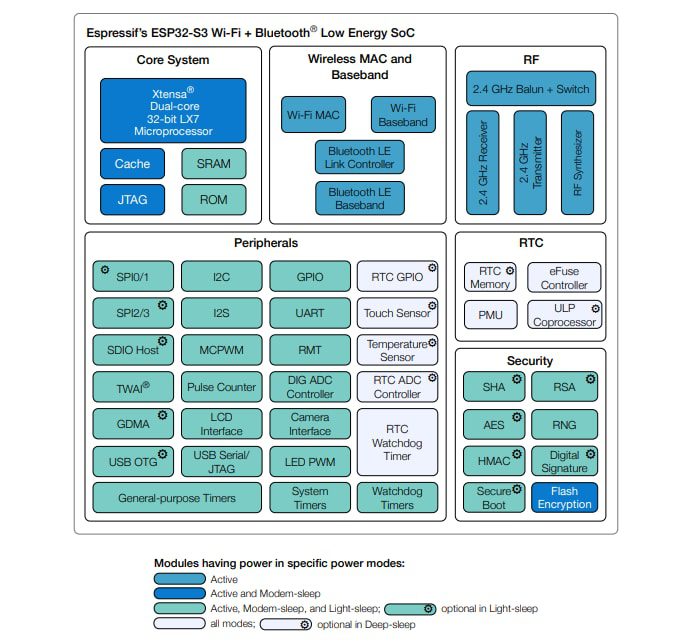
Block Diagram

Block Diagram - Espressif Systems ESP32-S3 2.4GHz Wi­-Fi® & BLUETOOTH® LE SoCs

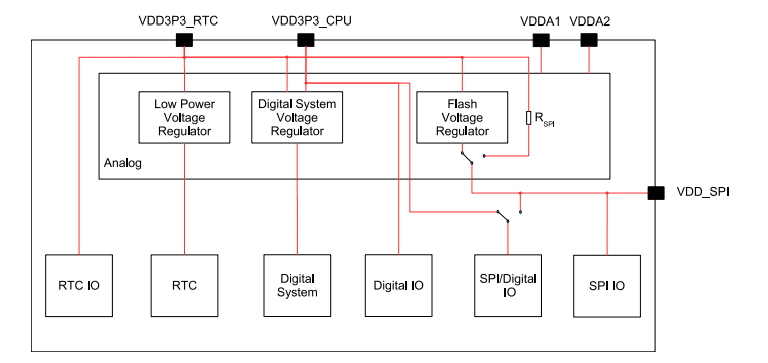
Power Scheme

Application Circuit Diagram - Espressif Systems ESP32-S3 2.4GHz Wi­-Fi® & BLUETOOTH® LE SoCs

Espressif Systems ESP32-S3 2.4GHz Wi­-Fi® & BLUETOOTH® LE SoCs