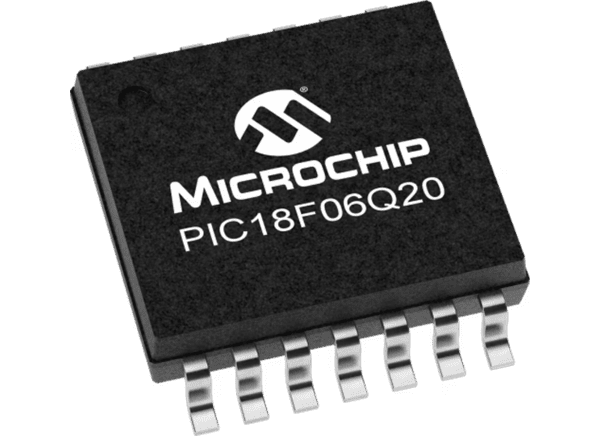
Microchip Technology PIC18-Q20 Microcontrollers

Microchip Technology PIC18-Q20 Microcontrollers are one of the smaller PIC18 product families available in 14/20-pin devices for sensor-interfacing, real-time control, and communication applications. This family showcases the Improved Inter-Integrated Circuit® (I3C) Target module with a higher communication rate and a 10-bit 300ksps ADC with Computation for responsive sensor designs. The family features a MultiVoltage I/O (MVIO) interface with multiple pins powered by VDDIO2 and VDDIO3, allowing these pins to operate at a different voltage domain than the rest of the microcontroller. The Microchip Technology PIC18-Q20 also features the 8-bit Signal Routing Port module to interconnect digital peripherals without using external pins. Additional features include a vectored interrupt controller with fixed latency for handling interrupts, a system bus arbiter, Direct Memory Access (DMA) capabilities, UART with support for asynchronous, DMX, DALI, and LIN protocols, SPI, I2C, and a programmable 32-bit CRC with memory scan. The Microchip Technology PIC18-Q20 family also includes Memory Access Partition (MAP) and SAFLOCK to support users in bootloader applications. SAFLOCK allows one-time programmability of the Storage Area Flash (SAF). The Device Information Area (DIA) stores factory calibration values to help improve temperature sensor accuracy.
Features

  • C compiler-optimized RISC architecture
  • Operating speed
    • DC – 64MHz clock input
    • 62.5ns minimum instruction cycle
  • Four Direct Memory Access (DMA) controllers
  • Vectored interrupt capability
  • 128-level deep hardware stack
  • Low-current Power-on Reset (POR)
  • Configurable Power-up Timer (PWRT)
  • Brown-out Reset (BOR)
  • Low-power BOR (LPBOR) option
  • Windowed Watchdog Timer (WWDT)
  • Operating characteristics
    • Operating voltage range (VDD) of –1.8V to 5.5V
    • Multi-voltage I/O (MVIO) Range (VDDIO2 and VDDIO3) of –1.62V to 5.5V (3.63V with I3C enabled)
    • Temperature range
      • Industrial: -40°C to 85°C
      • Extended: -40°C to 125°C
  • Memory
    • Up to 64KB of program Flash memory
    • Up to 4KB of data SRAM memory
    • 256bytes data EEPROM
    • Memory access partition: The program Flash memory can be partitioned into
      • Application block
      • Boot block
      • Storage Area Flash (SAF) block
    • Programmable code protection and write protection
    • Device Information Area (DIA) stores
      • Temperature indicator factory calibrated data
      • Fixed Voltage Reference (FVR) measurement data
      • Microchip unique identifier
    • Device Characteristics Information (DCI) area stores
      • Program/erase row sizes
      • Pin count details
      • EEPROM size
    • Direct, indirect, and relative addressing modes
  • Power-saving functionality
    • Doze: CPU and peripherals running at different cycle rates (CPU Is typically slower)
    • Idle: CPU halted while peripherals operate
    • Sleep: Lowest power consumption
    • Peripheral Module Disable (PMD)
    • Low-power mode features
      • Sleep: < 1µA typical @ 3V
      • Operating current is 48µA @ 32kHz, 3V, typical
  • Digital peripherals
    • Two 16-bit Pulse-Width Modulators (PWM)
    • Two 16-bit timers (TMR0/1)
    • Two 8-bit timers (TMR2/4) with Hardware Limit Timer (HLT)
    • Two 16-bit universal timers (TU16A/16B)
    • Four Configurable Logic Cells (CLC)
    • One Complimentary Waveform Generator (CWG)
    • Two Capture/Compare/PWM (CCP) modules
    • Programmable CRC with memory scan
    • Two UART modules
    • One SPI module
    • One I2C module, SMBus, PMBus™ compatible
    • Up to two I3C modules
    • One signal-routing port module
    • Peripheral Pin Select (PPS)
  • Analog peripherals
    • 10-bit Analog-to-Digital Converter with computation (ADCC)
    • Voltage reference
  • Clocking structure
    • High-precision internal oscillator block (HFINTOSC)
    • 32kHz Low-Power Internal Oscillator (LFINTOSC)
    • External 32kHz Crystal Oscillator (SOSC)
    • External high-frequency oscillator block
    • Fail-safe clock monitor
    • Oscillator Start-up Timer (OST)
  • Programming/debug features
    • In-Circuit Serial Programming™ (ICSP™) via two pins
    • In-circuit debug (ICD) with Three Breakpoints via two pins
    • Debug integrated on-chip

Applications

  • Automotive
  • Industrial control
  • Computing
  • Consumer electronics
  • Medical devices
  • Wearables
  • Touch sensing
  • Memory management

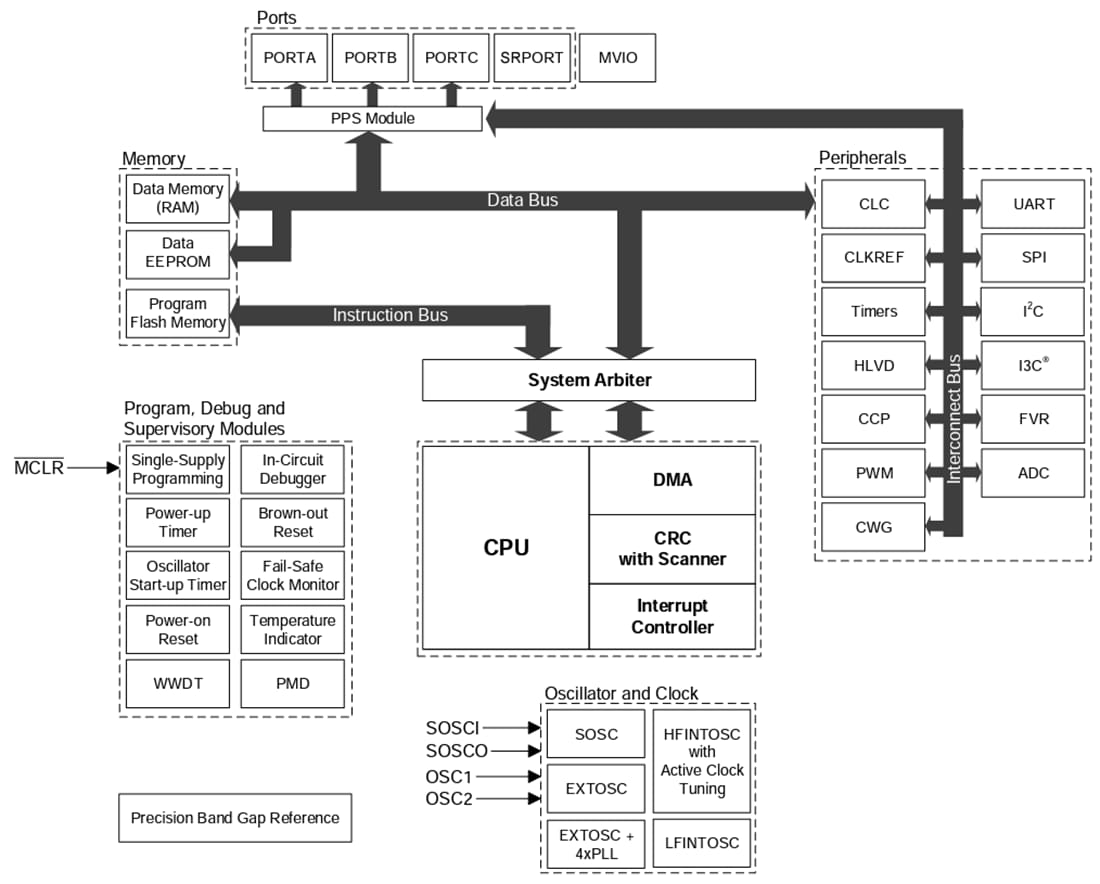
Block Diagram

Microchip Technology PIC18-Q20 Microcontrollers

Videos

Microchip Technology PIC18-Q20 Microcontrollers